


Table of Contents
How AI Is Reshaping Modern Trading Strategies
AI has moved from the trading desks of quant hedge funds into tools any retail trader can subscribe to. In practice, AI for trading means software that scans market data, spots patterns, and either surfaces signals or executes trades under rules you set. This guide covers the main tools and bots, where they genuinely help, and, just as importantly, where they fall short.
Key Takeaways
- AI trading tools scan data, flag setups, and can place trades, but they change the speed of your decisions, not the odds behind them.
- Cost is the number you can be sure of: Trade Ideas’ HOLLY runs $178/mo ($2,136/yr), an 8.5% hurdle on a $25,000 account before you earn a cent.
- The base rate is sobering. In one Taiwan Stock Exchange study, more than 8 in 10 day traders lost money over six months.
- Treat any “our AI can’t lose” pitch as a warning sign; the SEC has already brought “AI washing” cases.
Last updated July 2026. Tool pricing was checked on each vendor’s site and every statistic is linked to its original source.
Why Do Traders Rely on AI in 2026?
AI has changed how markets work, and trading is no exception. It lets traders act in milliseconds, read far more data than any person could, and test ideas that once took days. This guide covers how AI for trading actually works, the main tools and bots available in 2026, what they cost, and the risks that come with automating your decisions.
Disclaimer: This article is for educational and informational purposes only and is not financial, investment, or trading advice. Trading and investing carry a substantial risk of loss, and past performance does not guarantee future results. AI tools do not remove that risk. Always do your own research, and consider consulting a licensed financial professional before making investment decisions.
Evolution of AI in Financial Markets
AI did not arrive in trading overnight. Its use in financial markets has built up over four decades, from simple rule-based fraud checks to the models running today.
Early Adoption and Developments
Banks were among the first to use AI. In the 1980s they built rule-based systems to spot odd transactions and flag likely fraud. Security Pacific National Bank, for example, set up a fraud task force in 1987 to fight debit card misuse. Those early tools paved the way for the trading systems in use today.
Recent Advancements
AI has moved quickly in the past ten years, helped by better machine learning, cheaper data, and far more computing power. Quant funds such as High-Flyer Quant now build their own AI trading models, and their strategies have been influential enough to shape how markets behave.
Applications of AI in Trading
AI now touches almost every stage of the trading process. These are the areas where it is used most heavily, and what it actually does in each one.
Algorithmic Trading
Algorithmic trading runs on fixed rules: buy when these conditions line up, sell when those do. Adding AI lets the rules adapt as the data shifts instead of staying frozen, which can trim costs and soften the market impact of a large order.
High-Frequency Trading (HFT)
High-frequency trading (HFT) uses AI to place huge numbers of trades in fractions of a second. The models read market data and act on small price gaps long before a person could react. HFT can add liquidity to a market, but it can also make sharp moves worse, which is why it draws scrutiny.
Predictive Analytics and Market Forecasting
Because AI can read huge amounts of data, traders use it to estimate where prices may go next. Machine learning models pick up patterns and links a human analyst might miss. That can give an edge, but it is an estimate, not a forecast you can rely on.
Sentiment Analysis
AI reads news, earnings calls, and social posts to gauge the mood around a stock before it fully shows up in the price. Traders use that signal to anticipate how a market might react to an event. Open models such as DeepSeek have even been used to score companies and draft strategy code, which is part of why sentiment tools have spread so fast.
Risk Management
AI also helps manage risk. It watches trading patterns for anything unusual, flags likely fraud, and checks that activity stays within the rules, which protects both the trader and the firm.
AI for Stock Trading
In stock trading, AI is mainly used to sharpen estimates, spot trends, and place trades automatically. The main uses are:
- Stock price prediction: models weigh historical and live data to estimate where a price may move next.
- Portfolio optimization: tools suggest a diversified mix tuned to your risk tolerance and goals.
- Real-time market insights: live dashboards shorten the gap between spotting a move and acting on it.
- Automated execution: rules-based systems place buy and sell orders without you watching the screen.
Many hedge funds and institutional investors rely on AI-driven models for stock trading, as they help eliminate emotional bias and improve efficiency. Zoom out further with the best AI tools for finance.
AI Trading Bot
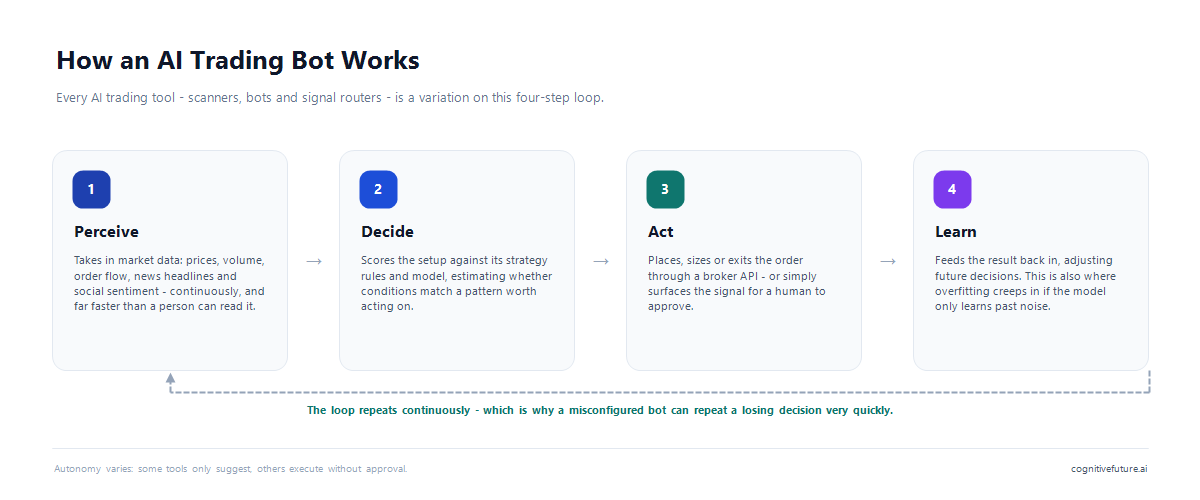
An AI trading bot is a program that places trades for you from a strategy you set. It uses machine learning to read market trends and time its orders. What it does well:
- 24/7 Monitoring: AI bots can watch markets around the clock and act as soon as their conditions are met. In genuinely 24-hour markets such as crypto they can trade continuously; on stock exchanges, orders still only execute during regular or extended trading hours.
- Data-Driven Decision Making: AI processes large volumes of market data in real time to flag setups that match its rules, far faster than a person could review them.
- Risk Management: AI bots apply stop-loss and take-profit rules automatically, though these limit losses rather than remove them, since a stop can still slip through a price gap.
- Customizability: Traders can adjust bot settings to align with their risk tolerance and investment goals.
Popular AI trading bots include Trade Ideas HOLLY, StockHero, and Tickeron, all of which provide automated trading capabilities tailored to different strategies and risk levels.
AI Trading Tools
Six of the better-known AI trading platforms are compared below, with what each is really for and the catch worth knowing before you pay:
| Tool | Free tier / trial | Starting price | Best for |
|---|---|---|---|
| Trade Ideas (HOLLY) | Free limited account | $89/mo, but HOLLY needs Premium at $178/mo | Real-time AI stock scanning |
| TrendSpider | No free tier; 14-day trial for $19 | From $82/mo (about $51/mo billed annually, promotional) | Automated technical analysis |
| StockHero | 14-day trial; no free plan | $49.99/mo (Lite tier, TradeStation only) | No-code trading bots |
| Tickeron | Free basic account + 14-day trial | Plans listed $60–$1,500 per year | AI robots and pattern signals |
| MetaStock | Not published | Quote-based; subscription or one-time purchase | Desktop charting and backtesting |
| SignalStack | Free: 5 live signals per month | $27/mo for 50 signals (usage-based) | Turning alerts into broker orders |
- Trade Ideas runs HOLLY, an AI that scans the market in real time and surfaces trade ideas for day and swing traders. The catch: the AI sits on the $178/mo Premium tier, not the $89 entry plan.
- TrendSpider automates the chart work, drawing trendlines, testing strategies, and reading many indicators at once. It suits traders who live in technical analysis.
- StockHero lets you build no-code bots and try them in paper trading, across several exchanges, before risking real money.
- Tickeron is a marketplace of pre-built AI bots and pattern signals, pitched at different risk levels rather than one-size-fits-all.
- MetaStock is the veteran desktop option, built for serious charting and backtesting rather than hands-off automation.
- SignalStack does one job well: it turns your alerts into real broker orders in seconds, billed by how many signals you fire rather than a flat fee.
Between them, these tools cover market analysis, risk control, and automation, so most traders can find one that fits how they work. On the sell-side, the best AI tools for investment banking go further.
How we checked these prices
Every figure above came from the vendor’s own pricing page in July 2026, not from third-party roundups. Where a vendor does not publish a standard rate we say so rather than repeat a number from elsewhere: Tickeron lists plans only as an annual range, and MetaStock quotes through sales. We also checked which tier actually includes the AI, which is how we found that the HOLLY engine sits on Trade Ideas’ $178/mo Premium plan rather than the $89/mo entry plan.
What this guide is not: we have not traded live with these platforms. This is a pricing, feature and risk comparison built from vendor documentation and published research, not a performance review. We deliberately leave out vendor win-rate and return claims, because none of them are independently audited.
What Do AI Trading Tools Actually Cost?
The subscription is the one number you can be sure of before you start, so it is worth doing the arithmetic. A tool has to beat your current approach by more than its own cost before it has earned anything.
Trade Ideas Premium, the tier that actually includes HOLLY, is $178 a month, or $2,136 a year. On a $25,000 account that is an 8.5% annual hurdle before broker fees; on a $10,000 account it is over 21%. At the other end, SignalStack Basic at $27 a month is $324 a year, roughly 3.2% on a $10,000 account. These figures do not tell you whether a tool is any good. They tell you how far past break-even it has to get.
The advertised price is rarely the real price
- The AI can sit on a higher tier. Trade Ideas advertises from $89/mo, but HOLLY needs the $178/mo plan, which is double.
- Market data is often extra. TrendSpider charges roughly $7.50 to $29 a month on top of the subscription for data feeds.
- Some pricing scales with use. SignalStack bills by signal volume, so an active strategy can reach its $340/mo tier.
- Promotional annual rates renew higher. TrendSpider’s discounted annual rate is introductory, not the standing price.
- Some vendors will not quote publicly. MetaStock prices through sales, and Tickeron publishes only an annual range.
When an AI trading tool is not worth it
Sometimes the math simply does not work. If your account is small, the subscription alone is a bigger drag than most strategies realistically overcome. If you trade only occasionally, a real-time scanner sits idle most of the month. And if you do not already have a strategy you can write down as rules, automating it mainly means making the same decisions faster.
It is also worth knowing the base rate. Research on retail day trading is consistently sobering: studying the Taiwan Stock Exchange, Barber, Lee, Liu and Odean found that more than eight in ten day traders lost money in a typical six-month period (Barber et al., 2004). Their later study of trader skill was starker still: fewer than 1% reliably earned positive returns after fees (Barber et al., 2014). Automation changes how fast those decisions happen, not the odds behind them.
One rule change worth knowing (2026)
Many guides still say you need $25,000 in your account to day trade. That is now out of date. FINRA has removed the pattern day trader designation and the $25,000 minimum equity requirement, effective June 4, 2026, replacing them with real-time intraday margin standards (FINRA Regulatory Notice 26-10). A $2,000 minimum still applies to margin accounts under Rule 4210, member firms have until October 2027 to implement the change, and individual brokers may still set stricter house rules, so check with yours rather than assuming.
How to Judge an AI Trading Claim
Marketing for these tools leans hard on performance figures, and almost none of them are independently audited. These are the questions that expose a weak claim.
- Is it backtested or live? A backtest is a simulation over past data. Forward, live results mean far more and are far rarer.
- Over what period, and which market? A strategy tested only through a long bull run tells you little about how it behaves in a shock.
- Does the number include costs? Spreads, commissions and slippage can turn a profitable-looking backtest into a losing one.
- What happened to the strategies that failed? If only survivors are shown, the average is flattered by survivorship bias.
- Is a win rate doing the work? A high win rate with occasional very large losses can still lose money overall.
Regulators take the same view. The SEC, NASAA and FINRA issued a joint investor alert warning about pitches such as “our proprietary AI trading system can’t lose” and claims that AI can guarantee returns (SEC, NASAA and FINRA, 2024). The SEC has since brought enforcement actions for “AI washing”, where firms overstate their use of AI, settling its first two such cases in March 2024 (SEC, 2024).
Research and Insights
Independent analysis of AI in markets is still emerging. Here is what three widely cited sources say about both its benefits and its risks.
AI’s Impact on Market Efficiency and Volatility
The International Monetary Fund (IMF) highlights that AI can enhance market efficiency by enabling rapid data processing and decision-making. However, this increased speed may also lead to higher trading volumes and greater volatility during periods of market stress (IMF). Its Global Financial Stability Report goes further, putting algorithmic trading at roughly 70% of US equities trading and warning that AI may deepen short-term volatility, with algorithms pulling liquidity during periods of stress (IMF Global Financial Stability Report, October 2024).
AI in Investment Decision-Making
In a 2024 piece, Forbes argues that AI is shifting investing away from older methods towards data-led ones. Reading large datasets, it says, allows sharper judgments about credit quality and investment risk. (Forbes)
AI Accessibility in Trading
Investopedia looks at how open-source AI, such as DeepSeek, is putting advanced trading tools within reach of more people. The catch is that running them well still takes real infrastructure and compliance work. (Investopedia)
What Are the Risks and Limits of AI Trading?
AI trading tools are powerful, but they are not a shortcut to reliable profits. These are the limitations that matter most before relying on one:
- Backtests overstate results. A strategy tuned until it looks excellent on historical data is often overfitted, having learned past noise rather than a durable edge, and performance frequently degrades in live trading.
- Models break when the market regime changes. Systems trained on calm or trending markets can fail badly during shocks, gaps, and sudden volatility, precisely when losses are largest.
- Costs erode returns. Spreads, commissions, slippage, and subscription fees all subtract from results, and higher-frequency approaches are especially sensitive to execution costs.
- Automation does not remove risk. Stop-losses can slip through price gaps, connections and APIs fail, and a misconfigured bot can execute a losing strategy faster than any human would.
- Opacity makes errors hard to spot. Many models give little explanation for a given signal, which makes it difficult to distinguish a genuine edge from coincidence.
- Systemic effects. The IMF has warned that while AI can improve market efficiency, it may also amplify volatility when many participants react to similar signals at once (IMF).
Frequently Asked Questions
Short answers to the questions traders most often ask about AI trading tools.
Can AI predict the stock market?
No, not reliably. AI can find patterns in historical and live data and estimate probabilities, but markets are moved by unpredictable events, and no model forecasts prices with consistent accuracy. Treat any tool that promises dependable predictions with skepticism.
Are AI trading bots profitable?
Some are and many are not. Results depend far more on the strategy, market conditions, and costs than on the software itself. Vendor win-rate and return claims are generally not independently audited, and backtested results in particular tend to overstate live performance.
Is AI trading legal?
Yes. Automated and algorithmic trading is legal in most major markets and is used heavily by institutions. You are still responsible for following your broker’s terms and local regulations, and some brokers restrict automated order flow or require approval for API access.
How much do AI trading tools cost?
Entry plans generally run from about $27 to $89 per month, but the AI features often sit on higher tiers. Trade Ideas’ HOLLY, for example, is on a $178/mo plan. Others price by usage or by annual plan instead. See the comparison table above for current figures, and the best AI tools for investing if you want options beyond active trading.
Conclusion
AI has changed how trading works: it automates the routine parts, sharpens strategy, and surfaces patterns people would miss. Expect it to reach further into trading platforms as the tools improve. But the gains only hold if the basics are respected: clear rules, honest testing, and a human who understands what the system is doing. Traders focused on a specific market can go deeper with the best AI tools for stock analysis or the best AI tools for options trading.
References
- IMF (2024) – AI Can Make Markets More Efficient and More Volatile (retrieved 2026-07-24)
- IMF (2024) – Global Financial Stability Report, Chapter 3 (retrieved 2026-07-24)
- Barber, Lee, Liu & Odean (2004) – Do Individual Day Traders Make Money? Evidence from Taiwan (retrieved 2026-07-24)
- Barber, Lee, Liu & Odean (2014) – The Cross-Section of Speculator Skill (retrieved 2026-07-24)
- SEC, NASAA & FINRA (2024) – Investor Alert on AI and Investment Fraud (retrieved 2026-07-24)
- SEC (2024) – Charges over “AI Washing” (Press Release 2024-36) (retrieved 2026-07-24)
- FINRA (2026) – Regulatory Notice 26-10 (retrieved 2026-07-24)
- Forbes (2024) – AI in Financial Services: Transforming Stock Trading (retrieved 2026-07-24)
- Investopedia – How to Use AI in Your Investing (retrieved 2026-07-24)
📈 Looking to Take Your AI Investing Further?
This article is part of our complete guide on using AI for smarter, data-driven investment strategies.
👉 Mastering AI for Investing: A Complete Guide for Investors

Richard Johnson
Richard Johnson is an AI specialist at one of the world's largest technology companies, where he has spent the past three years helping organizations adopt AI. CognitiveFuture extends that work publicly: gathering the available evidence on each tool, from vendor documentation to independent reviews and user feedback, and cutting a crowded market down to the right choice for the job in front of you.
