Disclosure: This article contains affiliate links. If you sign up for a paid plan through some of the links below, we may earn a commission at no extra cost to you. This never changes which tool we recommend or what we write about it.
Last updated: August 2026
- Most creators localizing YouTube or social videos → HeyGen
- Want the most natural-sounding voice and don’t need lip sync → ElevenLabs
- Agency handling batch localization across many clients → Rask AI
- Broadcast, news, or documentary distribution where accuracy is non-negotiable → Papercup
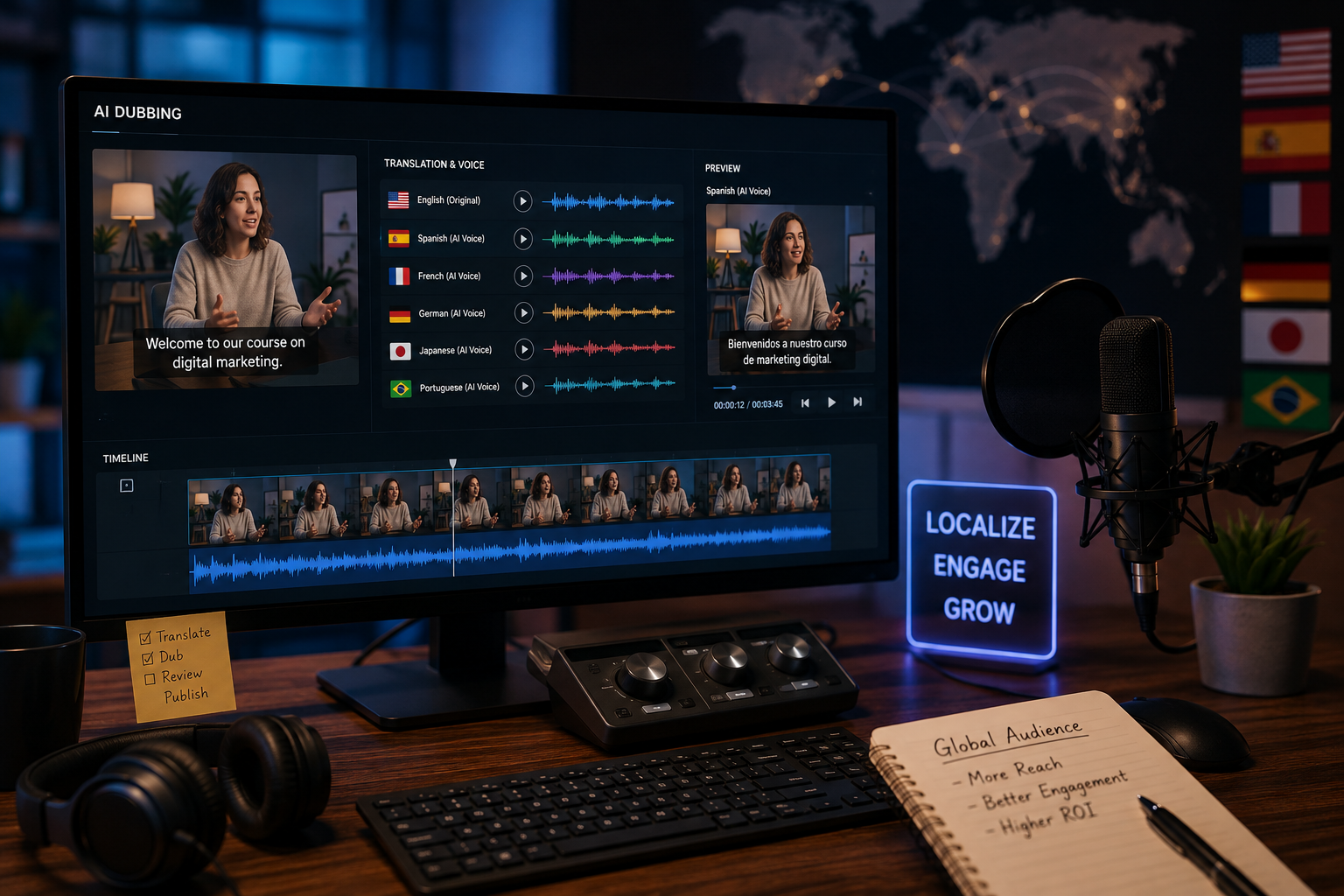
Dubbing a video into another language used to mean a recording studio, a voice actor, and a sync engineer. Now it’s a software problem, but “AI dubbing” bundles three separate jobs (translation, voice generation, and lip sync) and no tool is equally good at all three. We compared four platforms on cost per finished video, real-world lip-sync quality under normal shooting conditions, language coverage beyond the usual Western European languages, and whether a human being ever actually checks the output before it goes public.
How the Four Platforms Compare, Category by Category
| Category | Winner |
|---|---|
| Lip-sync accuracy | HeyGen |
| Voice naturalness | ElevenLabs |
| Cheapest for a single creator | HeyGen |
| Batch/agency workflow | Rask AI |
| Human quality control | Papercup |
- ✅ Lip-synced dubbing included
- ✅ $24/mo, no per-minute charges
- ✅ 175+ languages
- ✅ Most natural-sounding dubs
- ✅ 90+ languages
- ✅ Pay-as-you-go available
- ✅ Batch multi-video processing
- ✅ Built for multi-client workflows
- ✅ Collaborative review tools
- ✅ Native-speaking linguist review
- ✅ Used by BBC, Bloomberg, Sky News
- ✅ Built for accuracy-critical content
Choose HeyGen if… / Avoid it if…
Choose HeyGen if you’re localizing YouTube, social, or marketing videos and want lip-synced dubbing without tracking minutes. In 2026, HeyGen’s $24-a-month Creator plan includes lip-synced dubbing, voice cloning, and translation into 175+ languages with no per-minute charges, according to HeyGen’s own pricing page, making it the cheapest entry point for lip-synced output specifically.
Avoid HeyGen if your content leans heavily on extreme close-ups or unusual camera angles: reviewers note visible lip-sync artifacts in those specific scenarios, and language pairs with a bigger phoneme gap from English, like Japanese, show more visible mismatches than Spanish or French.
Choose ElevenLabs if… / Avoid it if…
Choose ElevenLabs if voice naturalness matters more than lip sync, for example podcast-style video, voiceover-heavy explainers, or B-roll content where the speaker’s face isn’t in frame most of the time. As of 2026, ElevenLabs does not offer lip syncing as part of its Dubbing product itself; lip sync is only available through third-party models inside its separate Image & Video, Flows, and Studio tools, per ElevenLabs’ own documentation.
Avoid ElevenLabs if you’re dubbing into several languages on a budget: it charges separately per target language, and the Creator plan’s roughly 12 minutes of included Dubbing Studio time a month disappears fast once you multiply one video by three or four languages. See our full ElevenLabs review for the platform beyond dubbing specifically.
Start free on ElevenLabs – no credit card required →Choose Rask AI if… / Avoid it if…
Choose Rask AI if you’re an agency or media team localizing a steady volume of videos across multiple clients and need batch processing and collaborative review built in, not bolted on. Rask’s workflow tools are built around handling many videos at once, which is exactly the workload a single-creator tool like HeyGen isn’t optimized for.
Avoid Rask AI if you’re an occasional or solo user: as of 2026, Rask’s Creator plan runs $60 a month, lip sync doubles your credit consumption (a 10-minute video with lip sync uses 20 minutes of plan allowance), and its overage rate of $3.00 per minute is the most expensive among the major platforms we checked. The pricing is built for volume, and it punishes anyone below that volume.
Choose Papercup if… / Avoid it if…
Choose Papercup if the content is public-facing in a way where an inaccurate dub is genuinely costly: news broadcasting, documentaries, or corporate content going to a global audience under your brand name. Papercup pairs AI dubbing with human editorial review, and every dubbed script is checked by native-speaking linguists before final audio generation, according to Papercup’s own workflow description. Its client list includes Bloomberg, the BBC, Sky News, and Business Insider.
Avoid Papercup if you want to self-serve: it offers custom, per-minute enterprise quotes only, with no published self-serve pricing and no free tier, so you can’t test it without a sales conversation.
What We Actually Checked
We compared official 2026 pricing pages for all four tools, cross-referenced user reviews on G2 and Reddit for real quality complaints, and checked each vendor’s own documentation for what it does and doesn’t include (lip sync specifically, since that’s the most commonly misunderstood gap in dubbing tools).
- Pricing math: Converted published plans into cost per finished video across a common multi-language localization scenario.
- Lip-sync claims: Checked against reported artifacts and language-pair-specific limitations, not just vendor demo reels.
- Human review availability: Verified directly against each vendor’s own workflow documentation.
Dubbing Isn’t One Job, It’s Three
“AI dubbing” sounds like a single feature, but it’s actually translation, voice generation, and lip sync stacked together, and most tools are strong at one or two of the three, not all three. A dub sounds robotic when a tool treats it as a text-to-speech problem instead of a performance problem: a synthetic voice with flat emotion, dialogue crammed into the wrong timing, and lips that don’t match the new audio.
That’s why ElevenLabs and HeyGen make different trade-offs on purpose. ElevenLabs optimizes for the voice itself sounding like a native speaker recorded it in a studio. HeyGen optimizes for the visual match between mouth movement and dubbed audio. Neither is wrong, they’re solving different halves of the same problem. Here’s how the four platforms actually hold up at each stage of that pipeline, translation first, then voice and lip sync.
Step One: Does the Translation Actually Hold Up?
Language coverage numbers look similar on paper (90+ for ElevenLabs, 175+ for HeyGen) but coverage isn’t the same as quality parity across all of them. Both platforms show measurably more friction outside Indo-European languages. ElevenLabs users report that Japanese business communication needs polite speech register, but the AI defaults to casual tone, and idiomatic phrases sometimes translate too literally, turning natural expressions into odd, stilted phrasing.
If your target market speaks a language with different formality rules or non-Latin script, budget time for a manual review pass regardless of which tool you pick. None of the four platforms fully solve for cultural and register-level nuance automatically, only Papercup’s human linguist review is designed to catch that specific class of error before publication.
Step Two: How Good Is the Lip Sync, Really?
HeyGen’s lip-sync corrections resynthesize mouth movements directly in the video to match dubbed audio, and reviewers describe Spanish and French dubs as convincing enough that a non-native speaker wouldn’t immediately clock it as dubbed. That praise comes with real limits: visible artifacts show up on extreme close-ups and unusual face angles, and Japanese specifically is harder because the phoneme gap from English is larger than with Romance languages.
ElevenLabs doesn’t compete in this category at all for its core Dubbing product, since lip sync isn’t part of it. Users report the dubbed audio doesn’t always match lip movements, which is expected rather than a bug, since the product isn’t solving for that. If lip sync matters to your project, evaluate ElevenLabs on voice quality alone and pair it with a separate lip-sync tool if you need one.
Step Three: Does Anyone Check the Result Before It Airs?
Only Papercup builds human review into its core workflow. Every dubbed script passes through native-speaking linguists before the final audio generates, which is the difference between a broadcaster like the BBC or Bloomberg using AI dubbing at all and staying with traditional studios. For a YouTube video, a wrong idiom is embarrassing. For a news segment, it’s a credibility problem.
ElevenLabs, HeyGen, and Rask AI are all fully automated with no built-in linguist review step. That’s fine for most creator and marketing use cases, but if you’re localizing anything with legal, medical, or safety implications, plan for your own human review pass regardless of which automated tool you use.
What a Real Project Actually Costs
As of 2026, take a common scenario: a 10-minute video localized into 3 languages, a typical first step for a creator or brand testing international audiences. The real cost per finished project varies enormously depending on whether a platform charges per minute, per language, or a flat monthly rate.
| Tool | Pricing model | Entry price | 10 min × 3 languages |
|---|---|---|---|
| HeyGen | Flat monthly, unlimited standard | $24/mo | Included in $24/mo |
| ElevenLabs | Per minute, per language | $0.50/min (Dubbing Studio) | ~$15 pay-as-you-go, or requires Pro plan ($99/mo) if using included Dubbing Studio minutes |
| Rask AI | Monthly credits, lip sync doubles usage | $60/mo (Creator) | 60 credit-minutes with lip sync, likely exceeds Creator allowance |
| Papercup | Custom enterprise quote | Contact sales | Not self-serve |
HeyGen wins this specific scenario clearly: its flat-rate plan absorbs a 3-language, 10-minute job with no extra charge. ElevenLabs’ per-language, per-minute pricing adds up fast once you go beyond one target language, since you’re paying the full rate again for each additional language rather than a bulk discount. Rask AI’s math only favors you once you’re running many videos a month, since lip sync alone doubles the credits a single job consumes.
Matching the Platform to the Job
| Persona | Pick | Why |
|---|---|---|
| YouTuber going multilingual | HeyGen | Flat pricing, lip sync included, cheapest for multi-language |
| Podcast or voiceover-heavy content | ElevenLabs | Best voice quality, lip sync not needed |
| Localization agency, multiple clients | Rask AI | Batch workflow built for volume |
| News, documentary, broadcast distribution | Papercup | Human linguist review before publication |
Where the Cracks Still Show
ElevenLabs users report voice consistency dropping on scripts over two minutes and credit exhaustion mid-project, with one common complaint being that changing a single word triggers a full paragraph re-render, burning credits unnecessarily. HeyGen’s lip sync gets visibly worse on close-ups and harder language pairs like Japanese. Rask AI’s pricing actively punishes low-volume use, with lip sync doubling credit consumption and the steepest overage rate of the four tools. Papercup’s biggest frustration isn’t quality, it’s access: no self-serve tier means you can’t even test it without an enterprise sales conversation.
- Dub a real clip with close-ups and normal talking-head shots, not just a demo, and watch the full thing.
- Test your actual target language, not just Spanish or French. Formality and phoneme gaps vary a lot by language.
- Calculate your real cost across every language you need, not just the first one, before comparing sticker prices.
- Decide upfront whether you need a human review step, and budget the time for it yourself if the tool doesn’t include one.
Frequently Asked Questions
Which AI dubbing tool has the best lip sync?
HeyGen has the strongest lip-sync accuracy among the tools we compared, resynthesizing mouth movements to match dubbed audio. It still shows artifacts on extreme close-ups and harder language pairs like Japanese, so test your actual footage before committing.
Does ElevenLabs offer lip-synced dubbing?
Not as part of its core Dubbing product as of 2026. ElevenLabs’ Dubbing feature focuses on voice and translation quality; lip sync is only available through third-party models in its separate Image & Video, Flows, and Studio tools.
How much does it cost to dub a video into multiple languages?
It depends heavily on the pricing model. HeyGen’s flat $24-a-month plan absorbs multi-language dubbing with no extra per-language charge, while ElevenLabs bills separately for each target language, which adds up fast for a 3+ language project.
Is AI dubbing good enough for broadcast or news content?
Only with human review. Papercup pairs AI dubbing with native-speaking linguist review before publication and is used by broadcasters including the BBC and Bloomberg. Fully automated tools skip that step, which is a real risk for accuracy-critical content.
Why does AI dubbing sometimes sound robotic?
It usually means a tool generated speech from scratch with flat emotion, forced the translated line into the wrong timing, or the lips visibly don’t match the new audio. The best tools address this by matching the timing and cadence of the original speaker’s delivery, not just translating the words.
Does dubbing quality hold up in non-European languages?
Not automatically. Users report formality mismatches (for example, defaulting to casual tone in languages like Japanese that expect business-appropriate register) and overly literal idiom translations. Budget a manual review pass for any language with different formality rules or non-Latin script.
Should I use subtitles instead of dubbing?
Subtitles are cheaper and faster, and they don’t carry any risk of lip-sync artifacts or mistranslated tone, since the viewer reads the original performance directly. Dubbing wins when your audience primarily watches on mobile with sound on, or when literacy or reading speed makes subtitles a worse experience, which is common for younger audiences and short-form video. Many creators run both: subtitles as a fast first step, dubbing for the languages that justify the extra cost.
Can I test these AI dubbing tools for free before paying?
HeyGen offers a free plan that lets you test lip-synced dubbing on a small number of videos before committing to a paid tier. ElevenLabs and Rask AI both offer limited free or trial usage, though the minutes included are small enough that a real evaluation usually means dubbing at least one full clip on a low-cost paid tier. Papercup has no free tier at all, since it’s built around custom enterprise quotes.
Final Verdict
For most people localizing video content, HeyGen is the safest starting point: flat pricing, included lip sync, and the widest language coverage of the four. Reach for ElevenLabs when the voice itself is what needs to sound perfect and lip sync isn’t in frame. Agencies handling steady multi-client volume should look at Rask AI despite the price, since the batch workflow tools pay for themselves at scale. And if the content is going to broadcast or a global news audience, Papercup’s human review step is worth the enterprise sales call.
For the platform behind the voice quality specifically, read our full ElevenLabs review. If you’re localizing training or course content rather than public video, our guide to AI voice for e-learning and course creation covers the narration side of that workflow. And for the broader post-production toolkit beyond dubbing, see our guide to AI tools for filmmakers.
Tool pricing and features change frequently. Always check the official website for the latest information before signing up.
Sources
- ElevenLabs, Dubbing documentation and pricing, retrieved 2026-08-04, https://elevenlabs.io/docs/overview/capabilities/dubbing
- ElevenLabs, “Do you offer lip sync in Dubbing?”, retrieved 2026-08-04, https://help.elevenlabs.io/hc/en-us/articles/23793433149073-Do-you-offer-lip-sync-in-Dubbing
- HeyGen, official pricing and product pages, retrieved 2026-08-04, https://www.heygen.com
- Rask AI, pricing breakdown, retrieved 2026-08-04, https://www.rask.ai
- Papercup, workflow and client information, retrieved 2026-08-04, https://www.papercup.com

Richard Johnson
Richard Johnson is an AI specialist at one of the world's largest technology companies, where he has spent the past three years helping organizations adopt AI. CognitiveFuture extends that work publicly: gathering the available evidence on each tool, from vendor documentation to independent reviews and user feedback, and cutting a crowded market down to the right choice for the job in front of you.