Last updated: August 2026
A wiring diagram is a map of physical connections, and the whole value of reading one is getting those connections exactly right. So “can AI read a wiring diagram” splits into two very different questions. Can a model explain what a symbol means, or teach you how a diagram is organized? Yes, and it is useful for that. Can it look at a real schematic and reliably tell you which terminal connects to which, so you can wire or troubleshoot from its answer? Not dependably, and trusting it there is how you short something out. Once the diagram is readable, the work moves on to a step-by-step cable sizing workflow, whether AutoCAD Electrical has AI, prompts for electrical engineers and cable sizing and voltage drop.
This guide separates those questions, shows where AI genuinely helps with a wiring diagram and where it fails, and gives a workflow that keeps a human checking every connection against the real drawing. It sits under our guide to AI tools for electrical engineers and is the electrical companion to our guide on whether AI can read GD&T drawings.
Short answer: AI can interpret and explain a wiring diagram, but it cannot be trusted to extract the actual connections without human verification. General vision models such as GPT-4o and Claude are useful for describing symbols, teaching how to read a diagram, tracing a single connection you point to, and drafting a plain-language description. They are unreliable at reading a dense schematic end to end, because they lose track of nodes and hallucinate wires that are not there. Benchmark research shows frontier models score far below humans on the spatial and topology reasoning that reading connections requires. Treat any connection an AI reports as unverified until you confirm it on the real drawing, and never wire or troubleshoot off AI output alone.
First, get the terms right
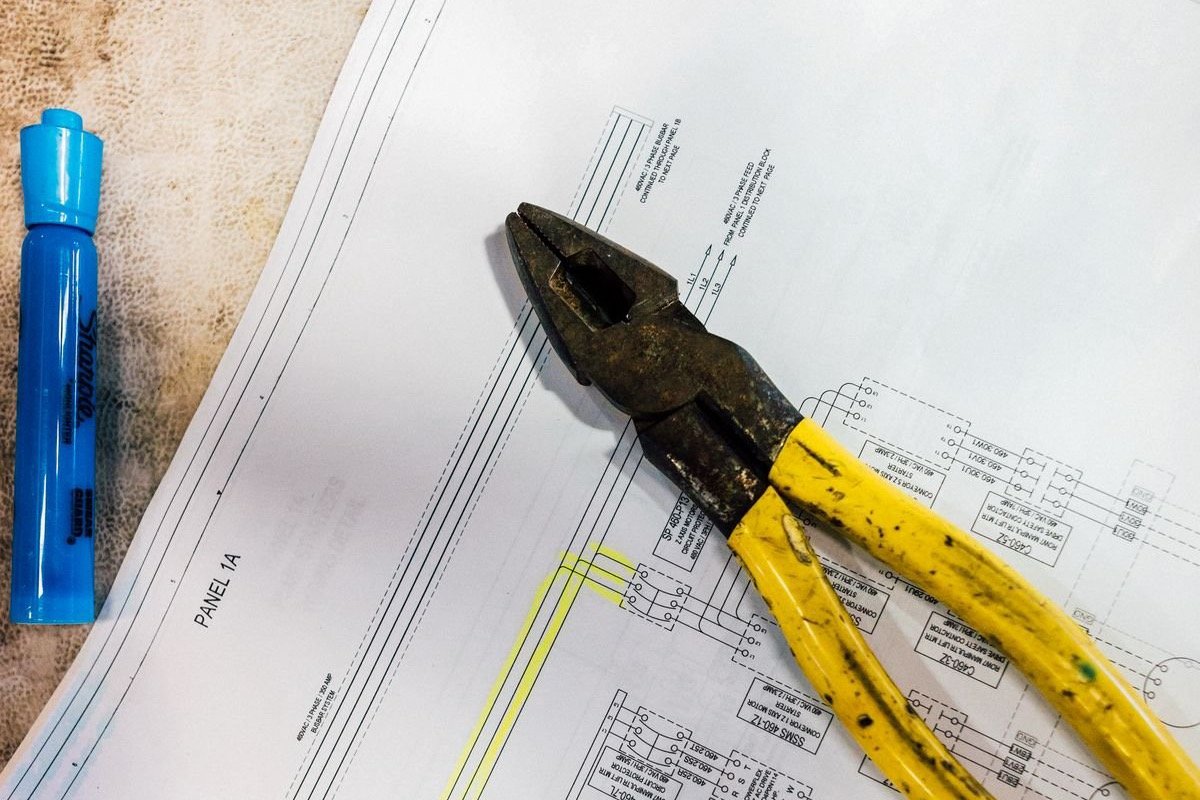
Three related drawings often get lumped together, and they answer different questions. A wiring diagram shows the physical connections and the relative positions of devices and terminals, so it is what you use to actually build or service an installation. A schematic shows functional logic through symbols and does not need to match the physical layout. A one-line, or single-line, diagram is the simplest power-distribution view, where a single line can represent several conductors at once. Knowing which one you are looking at matters, because asking a model to trace physical wiring off a functional schematic is asking the wrong question of the wrong drawing.
The symbols themselves are standardized. Internationally, IEC 60617 defines the graphical symbols for electrotechnical diagrams, with well over a thousand symbols for conductors, components, switchgear, and more (IEC). In the United States the historical reference is IEEE and ANSI 315, reaffirmed in 1993 and now largely superseded in practice by the IEC symbol set (ANSI). A model that learned one symbol convention can misname a symbol drawn in another.
Where AI genuinely helps
The useful cases are the ones that are about explanation rather than exact structure. A general assistant can explain what a symbol means, teach you how a wiring diagram is laid out, trace a single connection you point it to, summarize what a small circuit does, and draft a plain-language description for a report or a handover. Practitioners confirm the interpretive value: one engineer on the OpenAI developer forum reported pasting schematics and datasheets and having a circuit “correctly analysed” on a GPT-4 era model.
In each of those cases the model is helping you understand a diagram, not serving as the authoritative source of its wiring. That is the safe zone: you keep ownership of the connections, and the AI helps explain and communicate them.
Where AI fails, and where that gets dangerous
The failures show up the moment you need exact connections off a real diagram. A wiring diagram is a graph of nodes and edges, and following it correctly is spatial, topological work, which is exactly where vision models are weakest.
Benchmark research makes the gap concrete. On a controlled spatial-relations test, vision-language models that reach near human parity on general visual question answering fell to about 56 percent, against roughly 99 percent for humans, across all 18 models tested (Kamath et al., EMNLP 2023). On ElectroVizQA, a digital-electronics visual benchmark, the best model reached only about 62 percent and the average across models was about 54 percent, with the authors noting errors in perceiving basic logic-gate symbols (Sharma et al., 2024). And on CIRCUIT, a circuit-interpretation benchmark, GPT-4o scored about 48 percent on final answers and passed only about 27 percent under stricter evaluation, with the core difficulty being multi-level reasoning over circuit topology (Skelic et al., 2025).
The practical failure modes follow from that. On a dense schematic a model can invent a connection that is not there, drop a node it should have carried through, or confuse two nets that cross near each other. One user trying to get a model to reproduce a simple graph found it could not reliably draw even a single node with four connections coming out of it. Hand-drawn and low-resolution diagrams make all of this worse. And like every hallucination, a wrong connection arrives with the same confidence as a correct one, the fabricated-confidence problem we cover in how AI hallucinates in engineering work. A specialist model fine-tuned on circuit images can do better than a general chatbot, which is the real lesson: reliable diagram reading comes from a system trained for it, not from a general model asked to look at a photo.
How to use AI on a wiring diagram safely
You can get real value here without letting AI own a single connection. A defensible flow looks like this.
- Use AI to explain and teach. Ask what a symbol means, how the diagram is organized, or what a small section does. This is the strong case.
- Point it at one thing at a time. Tracing a single connection you specify is more reliable than asking it to read the whole diagram at once.
- Never trust an extracted connection blind. Treat any net, terminal, or wire the model reports as a claim to verify, not a fact.
- Verify against the real drawing. Confirm every connection on the actual wiring diagram, and confirm which drawing type you have, because a schematic does not show physical wiring.
- Keep a qualified person accountable. Wiring and troubleshooting decisions belong to a competent electrician or engineer; the AI assists, it does not certify.
For how the same discipline applies to a mechanical drawing rather than a schematic, see our guide on whether AI can read technical drawings.
Frequently asked questions
Can ChatGPT read a wiring diagram accurately?
It can explain symbols and interpret a small circuit, but it is not reliable at extracting the exact connections from a dense diagram on its own. Benchmark research shows frontier vision models score far below humans on spatial and topology reasoning, and they can invent or drop connections. Use it to understand and describe a diagram, then verify every connection against the real drawing, and never wire or troubleshoot from AI output alone.
What is the difference between a wiring diagram and a schematic?
A wiring diagram shows the physical connections and the relative positions of devices and terminals, so it is used to build and service an installation. A schematic shows the functional logic through symbols and does not have to match the physical layout. A one-line diagram is the simplest power view, where one line can represent several conductors. Asking AI to read physical wiring off a functional schematic confuses the two, so identify the drawing type first.
Can AI read a hand-drawn or low-resolution schematic?
That is the least reliable case. Hand drawing, faint scans, and crossing lines all degrade a model’s already-weak reading of symbols and connections, so errors go up sharply. Treat any AI reading of a hand-drawn or low-resolution diagram as a rough first pass, and confirm every detail against the original before acting on it.
Is any tool reliable enough to extract a netlist from a diagram photo?
Not from a general chatbot. Research shows specialist models trained specifically on circuit images outperform zero-shot frontier models, but even those are aids whose output an engineer checks, not a trusted netlist source. No general assistant should be treated as reliably converting a photographed diagram into verified connections; a human confirms the result against the real drawing.
Sources
- IEC 60617, Graphical symbols for diagrams
- IEEE and ANSI 315-1975 (R1993), Graphic Symbols for Electrical and Electronics Diagrams
- Wiring diagram (wiring vs schematic vs one-line)
- Kamath et al., What’s “up” with vision-language models? (EMNLP, 2023)
- Sharma et al., ElectroVizQA, digital-electronics visual QA (arXiv, 2024)
- Skelic et al., CIRCUIT, circuit interpretation benchmark (arXiv, 2025)
- OpenAI developer community, pasting schematics and datasheets
Written by the CognitiveFuture editorial team. We build our guidance from published standards and peer-reviewed research, and we label practitioner reports as such. We do not independently benchmark any tool, and we do not treat an AI-reported connection as reliable. Every connection must be verified against the actual wiring diagram, and wiring and troubleshooting decisions belong to a competent electrician or engineer.

Richard Johnson
Richard Johnson is an AI specialist at one of the world's largest technology companies, where he has spent the past three years helping organizations adopt AI. CognitiveFuture extends that work publicly: gathering the available evidence on each tool, from vendor documentation to independent reviews and user feedback, combined with hands-on testing where we have done it and said so, and cutting a crowded market down to the right choice for the job in front of you.