Table of Contents
What Are AI Agents? Definition & How They Work
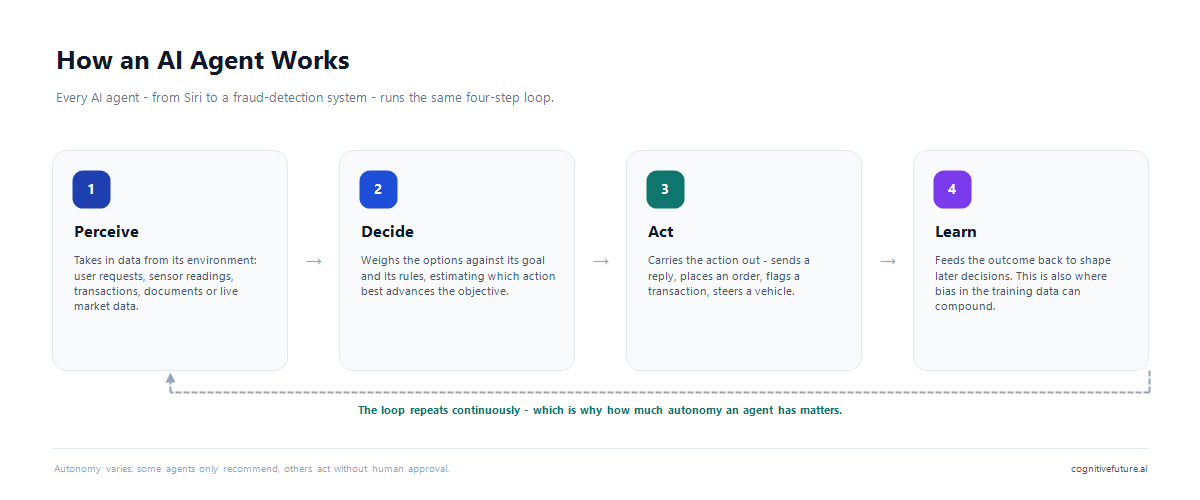
An AI agent is software that chases a goal for you, with little or no human input. What makes it different from ordinary software is how it works. It runs a loop. It senses what is happening, picks the action that best serves its goal, acts, then learns from the result. Every AI agent example in this guide runs that same loop, from Siri to fraud detection.
Last updated 19 July 2026. Every statistic below is dated and linked to its original source.
Key Takeaways
- An AI agent pursues a goal on its own through a perceive-decide-act-learn loop, from Siri to fraud detection.
- The results are real but mostly self-reported: TREWS was linked to an 18.7% relative drop in sepsis deaths, Klarna’s assistant did the work of about 700 agents, and GitHub Copilot users finished a task 55% faster.
- There are five classic agent types, from simple reflex to learning agents.
- The three risks worth watching are data privacy, bias, and job displacement.
Why Are AI Agents Showing Up in Every Industry?
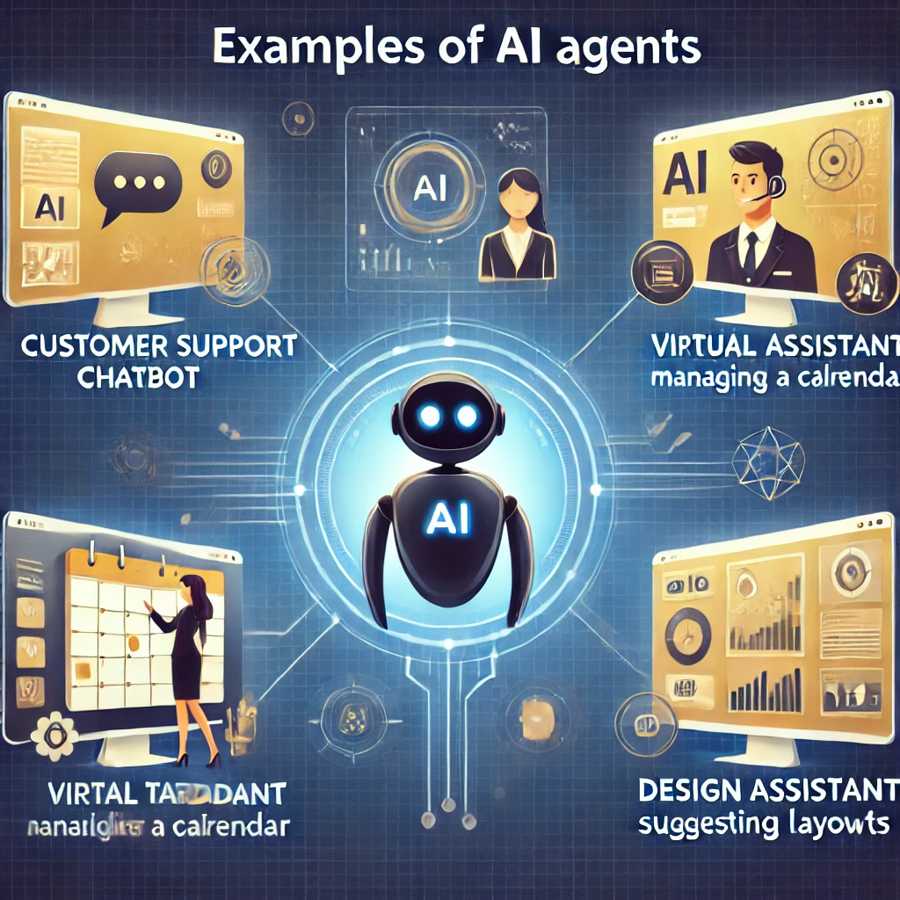
The clearest way to understand this technology is through real-world AI agent examples: the virtual assistants, recommendation engines, and fraud-detection systems you already use every day. Below are 10 of the most useful, spanning healthcare, finance, e-commerce and more.
AI agents now run in almost every industry. They handle routine work, sharpen decisions, and smooth the way people use products. Some are familiar, like Siri and Alexa. Others are hidden, like the systems that manage investment portfolios. Below we cover the main types, where they are used, and where the technology is heading.
Understanding AI Agents
Before the examples, it helps to know what an AI agent actually is and how the main types differ.
Definition of AI Agents
An AI agent is a piece of software built to do a job on its own, with little human input. It can plan, use tools, fix its own mistakes, reason through a problem, and work with other systems to reach a goal (SAP – What Are AI Agents).
Types of AI Agents
AI agents fall into five classic types, running from the simplest to the most capable:
- Simple Reflex Agents: Respond directly to environmental stimuli using condition-action rules without considering the broader context.
- Model-Based Reflex Agents: Maintain an internal model of the world, allowing them to handle partially observable environments by considering historical data.
- Goal-Based Agents: Act to achieve specific goals, evaluating future consequences of their actions to make decisions that align with these objectives.
- Utility-Based Agents: Aim to maximize a utility function, assessing various possible actions to select the one that provides the highest perceived benefit.
- Learning Agents: Continuously improve their performance by learning from experiences, adapting their behaviors based on new data (Botpress – AI Agents in the Real World).
| Type | How it decides | Everyday example |
|---|---|---|
| Simple reflex | Fixed condition-action rules | Thermostat |
| Model-based reflex | Keeps an internal world-state | Robot vacuum |
| Goal-based | Plans toward a goal | GPS routing |
| Utility-based | Maximizes a score | Ride-share pricing |
| Learning | Improves from feedback | Netflix recommendations |
How Are AI Agents Used Across Industries?
AI agents look different in each sector. Here is what they do in eight of the biggest, with a real deployment in each.
AI Agents in Healthcare
In hospitals, agents read scans, flag warning signs early, and take on the paperwork that eats into a clinician’s day. The highest-stakes ones watch patients around the clock and raise the alarm sooner than a person would.
Real-world example: TREWS is an AI agent built at Johns Hopkins and run by Bayesian Health. In a 2022 Nature Medicine study of 590,736 patients across five hospitals, sepsis patients whose alert a clinician confirmed within three hours received antibiotics a median of 1.85 hours sooner (Henry et al., 2022) and had an 18.7% adjusted relative reduction in in-hospital mortality, or 3.3% in absolute terms (Nature Medicine, 2022). In April 2024 the FDA cleared the first AI tool for diagnosing sepsis, Prenosis’s Sepsis ImmunoScore (CNBC).
AI Agents in Finance
In finance, AI agents watch for fraud, weigh risk, and place trades. They sift huge volumes of transaction data to spot patterns that look wrong. They also time trades to match market conditions.
Real-world example: Mastercard’s Decision Intelligence scores every transaction on its network in under 50 milliseconds. In 2024, the company said its generative-AI upgrade lifted fraud detection by 20% on average, and by up to 300% in some cases. It also says false declines on genuine purchases fall by as much as half (Mastercard).
AI Agents in Customer Service
Support is where most people first meet an AI agent. It answers routine questions instantly, at any hour, and passes the hard ones to a person. See our overview of AI agents.
Real-world example: In its first month, Klarna’s OpenAI-powered assistant handled 2.3 million conversations. That was about two-thirds of its customer-service chats, or the work of roughly 700 full-time agents. In 2024, Klarna said average resolution time fell from 11 minutes to under two (Klarna). However, Klarna later shifted back toward human agents for complex cases. It is a useful reminder that agents work best alongside people, not instead of them (CX Dive).
AI Agents in Manufacturing
On the factory floor, agents watch machines for the small signs that come before a breakdown. Spotting it early means replacing a part on schedule instead of scrambling when a line stops (InDataLabs – AI Agents in Business).
Real-world example: Siemens’s Senseye agents read sensor data from tens of thousands of machines. They forecast breakdowns 7–10 days ahead. In 2024, Siemens said this cut unplanned downtime by up to 50% (Siemens / Arm).
AI Agents in E-commerce
Online stores lean on agents to decide what you see and what it costs. They rank products to your taste, forecast demand so shelves are not left empty, and move prices with the market.
Real-world example: Amazon’s recommendation engine is the classic case. A widely cited McKinsey analysis from 2013 put recommendations behind roughly 35% of Amazon’s purchases, and McKinsey finds personalization can lift retail revenue by 10–15% (McKinsey). That Amazon figure is over a decade old, but it is still the most quoted benchmark.
AI Agents in Software Development
Coding assistants now sit inside the editor, suggesting whole functions, writing tests, and explaining unfamiliar code as a developer types. They act on the context of the whole file, not a single prompt.
Real-world example: In a 2022 controlled GitHub study of 95 professional developers, those using GitHub Copilot finished a coding task 55% faster than those without it: about 1 hour 11 minutes versus 2 hours 41 minutes. Slightly more of them finished the task at all, 78% against 70% (GitHub, 2022). It is GitHub’s own study on one well-scoped task, so treat 55% as a best case, not a figure for all software work.
AI Agents in Media and Streaming
Streaming services use agents to decide what to show you next, ranking thousands of titles against everything you have already watched. The aim is to keep you watching without making you search.
Real-world example: In a 2015 paper, Netflix said its recommendation system shapes what people pick for about 80% of the hours they stream, and has estimated that personalization and recommendations together are worth more than $1 billion a year in retained subscribers (ACM TMIS, 2015). Both are Netflix’s own 2015 estimates, so read them as the classic benchmark rather than today’s exact numbers.
AI Agents in Legal Work
In law and finance, agents read long contracts and pull out the clauses that matter, doing in seconds what once took people hours. A human still signs off, but the first pass is automated.
Real-world example: JPMorgan’s COIN (Contract Intelligence) reviews commercial-loan agreements that the bank says once took an estimated 360,000 lawyer and loan-officer hours a year, and now interprets them in seconds (Bloomberg, 2017). The number describes work once done by hand, not jobs cut, and comes from JPMorgan by way of Bloomberg.
Where Are AI Agents Deployed Today?
Here are the documented deployments covered above, gathered in one place, with what each one achieved and where the figure comes from.
| System | Sector | What the agent does | Documented result | Year | Source |
|---|---|---|---|---|---|
| TREWS (Bayesian Health) | Healthcare | Sepsis early warning | 18.7% adjusted relative drop in in-hospital mortality (3.3% absolute); antibiotics 1.85 h sooner | 2022 | Nature Medicine |
| Sepsis ImmunoScore (Prenosis) | Healthcare | Sepsis diagnostic | First FDA-authorized AI sepsis tool | 2024 | CNBC |
| Decision Intelligence (Mastercard) | Finance | Fraud scoring | Company reports +20% detection; scores in under 50ms | 2024 | Mastercard |
| Klarna assistant | Customer service | Support chat | 2.3 million chats in month one, about 700 agents of workload | 2024 | Klarna |
| Senseye (Siemens) | Manufacturing | Predictive maintenance | Company reports up to 50% less unplanned downtime | 2024 | Siemens |
| Amazon recommendations | E-commerce | Product recommendation | Estimated 35% of purchases | 2013 | McKinsey |
| GitHub Copilot | Software development | AI pair programmer | 55% faster task completion in a 95-developer study | 2022 | GitHub |
| Netflix recommendations | Media / streaming | Title recommendation | ~80% of streamed hours; est. >$1B/yr value | 2015 | ACM TMIS |
| COIN (JPMorgan) | Legal | Contract review | ~360,000 lawyer-hours/yr, now in seconds | 2017 | Bloomberg |
| Waymo | Transport | Autonomous robotaxi | About 500,000 paid rides per week | 2026 | TechCrunch |
What These Numbers Actually Mean
Headline figures get repeated far more often than they get read carefully. Here is what the numbers above do, and do not, say.
- 18.7% is a relative reduction, not an absolute one. Sepsis deaths fell by 18.7% against the baseline rate, which the same study puts at 3.3% in absolute terms. It does not mean 18.7% of patients were saved. The two get confused constantly, and the gap between them is large.
- Klarna’s 700 agents is a workload comparison, not a headcount cut. It describes the volume the assistant handled, expressed in agent-equivalents. It is not a count of jobs removed, and Klarna later brought human agents back for complex cases.
- Amazon’s 35% is a 2013 estimate. It is still quoted as though it were current. Treat it as a historical benchmark from the early days of large-scale recommendation, not a present-day measurement.
- The Mastercard and Siemens figures are company-reported. Both are plausible, but neither has been independently audited, and a phrase like “up to 50%” describes a best case rather than a typical one.
- Waymo’s ride count measures scale, not success. Half a million rides a week shows adoption. On its own it says nothing about safety records or whether the service makes money.
- The GitHub, Netflix, and JPMorgan figures are self-reported too. Copilot’s 55% comes from a single controlled task in GitHub’s own study, Netflix’s $1 billion and 80% are its own 2015 estimates, and JPMorgan’s 360,000 hours describes work once done by hand rather than jobs removed.
Which AI Agents Do You Already Use?
Beyond the industry use cases above, a few AI agents have become part of everyday life. These are the consumer-facing AI agent examples most people interact with directly.
Virtual Personal Assistants
Siri, Alexa, and Google Assistant sit on phones and smart-home devices. They set reminders, answer questions, and control appliances (PutItForward – Notable AI Agent Examples).
Autonomous Vehicles
Self-driving cars use AI agents to read sensor data and steer in real time. The goal is safer roads and smoother traffic.
Real-world example: By mid-2026, Waymo’s self-driving agents had scaled to roughly 500,000 paid robotaxi rides per week across 10 U.S. cities, a tenfold jump from about 50,000 per week in May 2024. The company is now targeting one million weekly rides (TechCrunch).
What’s Next for AI Agents?
Three shifts are shaping what agents will be able to do next.
Advancements in Natural Language Processing
Better natural language processing (NLP) is helping agents understand and write human language. That makes talking to them feel more natural.
Integration with Internet of Things (IoT)
Pairing AI agents with IoT devices creates smarter systems. In smart homes, cities, and factories, devices can talk to each other and act together.
Enhanced Personalization
Future agents should feel more personal, using your data to tailor what they suggest. Compare the leading AI agent tools.
What Are the Risks and Ethical Concerns of AI Agents?
The upside comes with real problems. These are the three that come up most often.
Data Privacy Concerns
An agent is only as useful as the data it can see: your messages, your location, your purchases, sometimes your medical records. That reach is also the risk. The more an agent holds, the more there is to leak, sell, or use against you, which is why data minimisation and clear consent matter more here than with ordinary software.
Bias and Fairness
An agent learns from past data, so it also inherits the unfair patterns in that data. A hiring agent trained on years of skewed decisions will tend to repeat them, at scale and behind a veneer of being objective. The fix is to test agents on real outcomes for real groups, not just on an overall accuracy score.
Job Displacement
As agents absorb routine tasks, some roles shrink, as Klarna found when it later walked its numbers back. The hard question is less whether jobs change than whether the people in them get the retraining and support to move into the work that is left.
Frequently Asked Questions
Short answers to the questions people ask most about AI agents.
What is an example of an AI agent?
A common AI agent example is a virtual assistant like Siri or Alexa. It hears a request, decides what action meets it, and carries that out on its own. Netflix recommendations, bank fraud checks, and self-driving car software are everyday examples too.
Are AI agents the same as chatbots?
No. A chatbot typically follows scripted or single-turn responses, while an AI agent perceives its environment, makes decisions toward a goal, and takes actions with minimal human intervention. Every AI agent can converse, but not every chatbot is an agent.
What are the main types of AI agents?
There are five classic types: simple reflex, model-based reflex, goal-based, utility-based, and learning agents. They run roughly from simplest to most capable.
Which industries use AI agents the most?
Healthcare, finance, customer service, manufacturing, and e-commerce lead the way. They use agents for diagnosis support, fraud checks, customer chat, predictive maintenance, and product recommendations.
Quick Takeaways
- AI agents are autonomous software systems that perform tasks with minimal human intervention.
- Types of AI agents include simple reflex agents, model-based agents, goal-based agents, utility-based agents, and learning agents.
- Industries benefiting from AI agents include healthcare, finance, customer service, manufacturing, e-commerce, software development, media, and legal work.
- Notable AI agent examples include virtual assistants (Siri, Alexa), self-driving cars, recommendation systems, and fraud detection models.
- Future trends involve improved natural language processing, IoT integration, and enhanced personalization.
- Challenges and ethical concerns include data privacy, bias, and job displacement.
- AI agents will continue evolving, bringing automation, efficiency, and innovation across sectors.
Conclusion
AI agents are changing how industries work. They take on routine tasks, sharpen decisions, and tailor what people see. As the technology improves, agents will handle more on their own. But the gains only hold if privacy, bias, and job displacement are taken seriously. Put agents to work on your site using AI for website design.
References
- SAP – What Are AI Agents? (retrieved 2026-07-24)
- Botpress – AI Agents in the Real World (retrieved 2026-07-24)
- PutItForward – Notable AI Agent Examples (retrieved 2026-07-24)
- InDataLabs – AI Agents in Business (retrieved 2026-07-24)
- MIT Technology Review – AI Trends & Future Applications (retrieved 2026-07-24)
- Nature Medicine (2022) – TREWS Sepsis Patient Outcomes Study (retrieved 2026-07-24)
- CNBC – FDA Authorizes First AI Sepsis Diagnostic (Prenosis) (retrieved 2026-07-24)
- Mastercard – Generative AI Fraud Detection (retrieved 2026-07-24)
- Klarna – AI Assistant First-Month Results (retrieved 2026-07-24)
- CX Dive – Klarna Rebalances Human Agents (retrieved 2026-07-24)
- Siemens / Arm – Edge AI Predictive Maintenance (retrieved 2026-07-24)
- McKinsey – How Retailers Can Keep Up With Consumers (2013) (retrieved 2026-07-24)
- TechCrunch – Waymo Ridership Growth (2026) (retrieved 2026-07-24)
- GitHub (2022) – Quantifying GitHub Copilot’s Impact on Developer Productivity (retrieved 2026-07-24)
- ACM TMIS (2015) – The Netflix Recommender System (Gomez-Uribe & Hunt) (retrieved 2026-07-24)
- Bloomberg (2017) – JPMorgan COIN Automates 360,000 Legal Hours (retrieved 2026-07-24)
📚 Explore More on AI Agents
If you’re interested in how AI agents are shaping productivity, planning, and automation, don’t miss our full overview:
👉 AI Agents Explained: Top Tools, Use Cases & Trends Shaping 2026

Richard Johnson
Richard Johnson is an AI specialist at one of the world's largest technology companies, where he has spent the past three years helping organizations adopt AI. CognitiveFuture extends that work publicly: gathering the available evidence on each tool, from vendor documentation to independent reviews and user feedback, and cutting a crowded market down to the right choice for the job in front of you.