Table of Contents
The Real Problem With Note-Taking Isn’t Capture
You already have hundreds of notes you’ll never open again. That’s the part nobody admits. Capturing information was solved years ago, first by keyboards, now by AI that transcribes every word of a meeting for you. The problem is what happens next. We forget well over half of new information within a day when we don’t revisit it, and keep losing more from there (Murre & Dros, PLOS ONE, 2015). Then we spend hours hunting for what’s left.
So this guide skips the “AI writes your notes for you” pitch. Instead it follows a note through its real life: capture, organize, retrieve. AI helps at every stage, but only one of those stages actually changes your life, and it’s not the one the tools advertise. Let’s walk through where each step breaks and which AI actually fixes it.
Capture: Getting It Down Without Missing the Moment
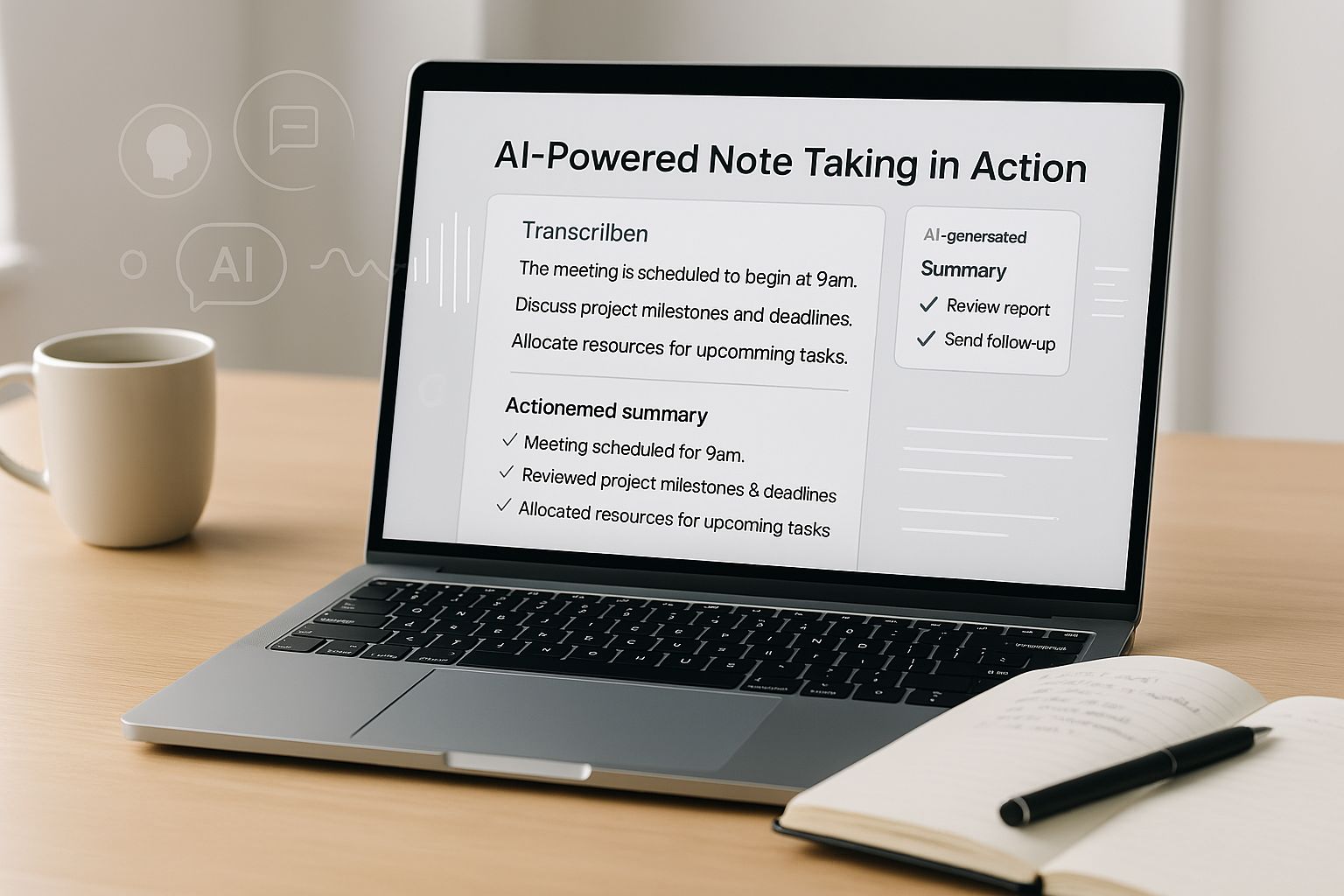
Capture is the stage AI has genuinely nailed. Adoption reflects it: in a 2025 industry survey, 75% of professionals reported using an AI note-taker in work meetings (Fellow, 2025). Tools now join your call, transcribe every speaker, and hand you a summary before you’ve closed the tab. The goal here isn’t more capture. It’s capturing without splitting your attention.
For live meetings, Otter, Fireflies, and Granola lead. Granola is the interesting one: you jot your own shorthand while it listens, then it merges your bullets with the full transcript, so the notes reflect what you thought mattered. For a personal thought or a voice memo, your phone plus a quick AI cleanup does the job. Since most of these are built for calls, our roundup of the best AI tools for meeting notes goes deeper on the meeting-specific picks.
Organize: Where Most Notes Go to Die
This is the stage everyone skips, and it’s why capture alone is a trap. A transcript you never file is just a longer thing to forget. The old fix was manual: tags, folders, a tidy system you stopped maintaining by week three. AI changes the economics by organizing as you write. Mem (rebuilt as Mem 2.0) auto-links and auto-tags notes and surfaces related ones as you type, which is the closest thing yet to notes that file themselves.
The reframe that matters: organizing isn’t about a tidy folder tree, it’s about making a note findable by the future you who forgot it exists. Notion AI works if your notes already live in Notion. Obsidian with AI plugins suits people who want local files and control. Reflect leans into daily notes and backlinks. Pick the one that fits how you already think, because the best system is the one you don’t have to maintain. For team knowledge bases, see the best AI tools for knowledge management.
Retrieve: Making Your Notes Answer Questions Later
Retrieval is where AI finally earns its keep, because this is the expensive problem. Knowledge workers spend about 1.8 hours a day, roughly 9.3 hours a week, just searching for information they often already have (McKinsey, 2012). That’s a full day a week lost to hunting. AI turns your notes from a pile you dig through into something you can simply ask.
Two tools stand out here. Google NotebookLM is free, and it lets you load your notes, PDFs, and transcripts, then ask questions and get answers grounded in your own sources with citations. Mem and Notion AI both let you query your workspace in plain language. You can also point ChatGPT or Claude at a batch of notes and ask for the through-line.
A concrete example: drop a quarter of meeting transcripts into NotebookLM and ask, “What did we decide about pricing, and who owned it?” It answers in seconds, with citations pointing to the exact meetings. That’s the whole shift, from scrolling through notes to asking them a question. Kevin Stratvert’s walkthrough shows how the retrieve step actually feels in practice.
The Catch: Privacy, Accuracy, and the Bot in the Room
The convenience has a cost, and it’s worth naming. When an AI note-taker joins a call, people notice: 84% of users say they change how they speak when one is present, and privacy is the top reason non-users stay away, cited by 50% of them (Fellow, 2025). A bot silently recording a candid conversation is a trust and compliance question, not just a feature.
Two rules keep you safe. First, always review AI summaries before you act on them, because transcription still mishears names, numbers, and anything said over crosstalk. Second, tell people when a bot is recording, and pick a private tool like Jamie or Krisp for sensitive calls. In this video, one creator argues a general assistant like Claude can now replace a dedicated note app, which is a useful provocation about where this is heading.
Which AI Note Tool for Which Job
Match the tool to the stage you’re weakest at, not to the longest feature list. If you capture fine but never find anything, your problem is retrieval, so start there. This table maps the strongest picks to each stage.
| Stage | Best tools | Use it when |
|---|---|---|
| Capture | Otter, Fireflies, Granola | You need meetings and calls transcribed and summarized automatically. |
| Organize | Mem, Notion AI, Obsidian, Reflect | Your notes pile up faster than you can file them. |
| Retrieve | NotebookLM, Mem, ChatGPT / Claude | You want to ask questions and get answers from your own notes. |
| Privacy-first | Jamie, Krisp | The conversation is sensitive and can’t leave your device. |
For the meeting-heavy end of this list, the best AI tools for meetings compares the transcribers in depth. And if note-taking is one piece of a bigger time-saving push, our AI for productivity guide puts it in context.
Frequently Asked Questions
What is the best AI note-taking tool?
It depends on your weakest stage. For transcribing meetings, Otter, Fireflies, and Granola lead. For finding answers in your own notes later, Google NotebookLM is free and excellent. There’s no single best tool, only the best tool for capture, organizing, or retrieval.
Is there a free AI note taker?
Yes. Google NotebookLM is completely free and strong for querying your notes and documents. Otter and Tactiq offer usable free tiers for meeting transcription, and general tools like ChatGPT and Claude can summarize notes at no cost on their free plans.
Are AI note-taking apps private and secure?
It varies, and it’s the top concern for non-users (Fellow, 2025). Cloud tools store your transcripts on their servers. For sensitive conversations, choose an on-device option like Jamie or Krisp, and always tell participants when a bot is recording.
Can AI organize my existing notes?
Yes, and this is where it shines. Mem auto-links and tags notes as you write, while NotebookLM and Notion AI let you ask questions across everything you’ve saved. That retrieval step matters because we forget well over half of what we don’t revisit within a day.
The Bottom Line
AI made capturing notes effortless, which quietly exposed the real problem: notes are worthless if you can’t find them again. Capture is solved. Organizing is where most notes die. Retrieval, the ability to ask your own notes a question, is the stage that actually gives you back the day a week you’d otherwise lose to searching. Choose your tool for that.
Start with the stage that hurts most. Then connect it to the rest of your stack with our guides to the best AI tools for meeting notes and AI for productivity.
Sources
- Murre JMJ & Dros J, “Replication and Analysis of Ebbinghaus’ Forgetting Curve,” PLOS ONE, 2015. journals.plos.org (retrieved 2026-07-26).
- McKinsey Global Institute, “The Social Economy: Unlocking Value and Productivity Through Social Technologies,” 2012 (knowledge workers spend ~9.3 hrs/week searching for information). mckinsey.com (retrieved 2026-07-26).
- Fellow, “The State of AI Meeting Notetakers” (vendor survey), 2025. fellow.ai (retrieved 2026-07-26).

Richard Johnson
Richard Johnson is an AI specialist at one of the world's largest technology companies, where he has spent the past three years helping organizations adopt AI. CognitiveFuture extends that work publicly: gathering the available evidence on each tool, from vendor documentation to independent reviews and user feedback, and cutting a crowded market down to the right choice for the job in front of you.